The Problem Isn’t Reach. It’s Design.


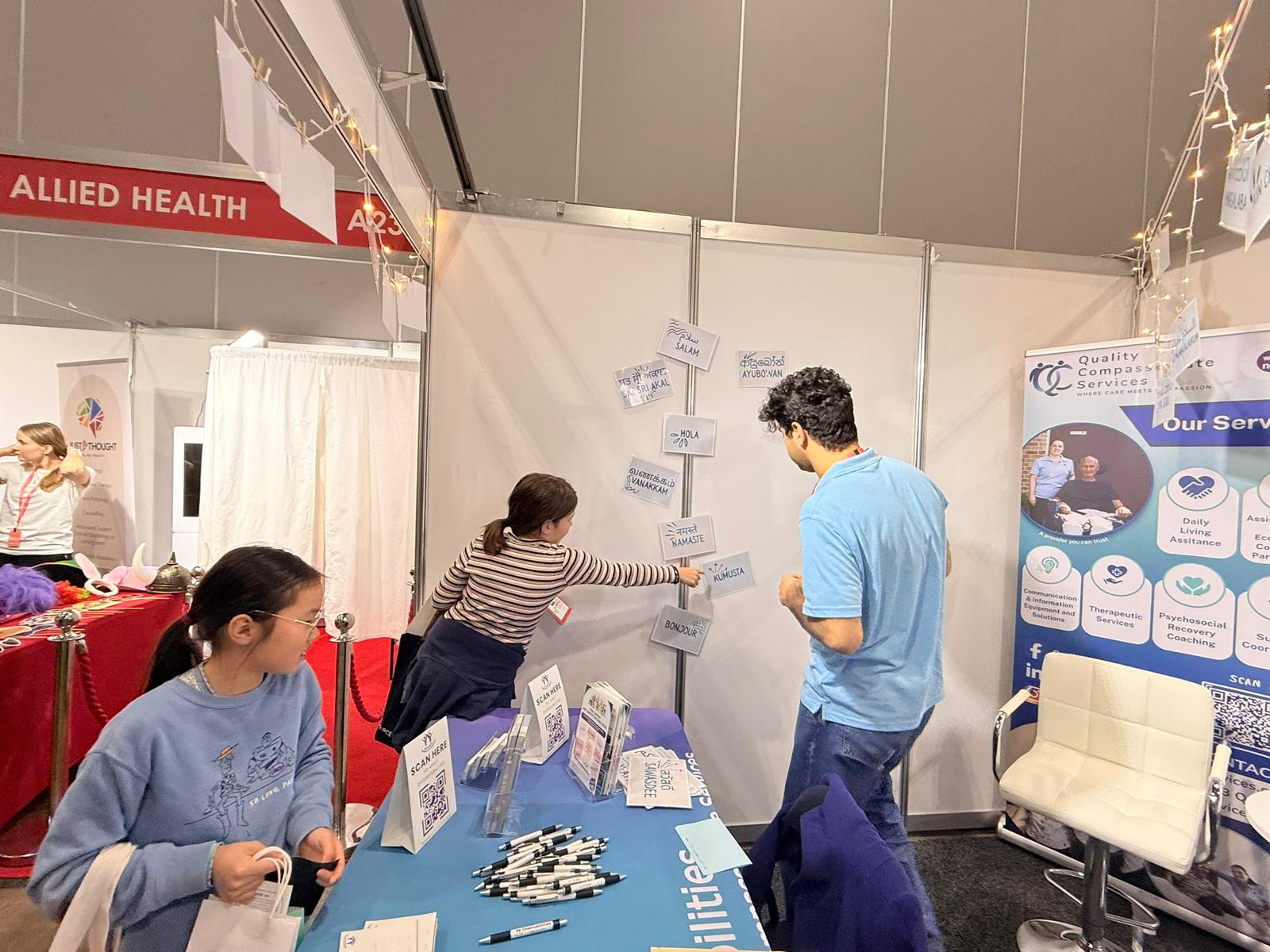
At an expo a few weeks ago we put up a wall of “hello” written in dozens of languages and asked people to find their own. It was meant to be a simple icebreaker, something to get a conversation going without shoving a clipboard in someone’s face.
A lot of families stopped in front of it. Kids got called over. People pointed things out to each other and talked quietly among themselves. One mum looked at the wall, then at us, and said she’d never seen her language at one of these events before.
We keep coming back to that sentence.
Recognition like that shouldn’t be rare at a disability services event, and the fact that it is tells you something about who this sector has usually been built for. It’s a big part of why DiversAbilities exists.
Hard to reach, or hard to design for?
The disability sector likes to describe culturally and linguistically diverse (CALD) communities as “hard to reach.” We think that’s the wrong way round. These communities aren’t disengaged. They’re underserved by systems that were never built with their language, culture, or trust in mind.
Reach puts the problem on the community. Design puts it on us, the providers and platforms and policymakers. DiversAbilities was built around the second version, with CALD communities part of the platform from the start rather than a translation job tacked on at the end.
What the research actually shows
The Disability Royal Commission spent years looking into this and landed on something that should bother anyone working in the sector: most organisations run a disability inclusion policy and a separate CALD inclusion policy, and the two rarely speak to each other. People sitting at the intersection of both, CALD Australians living with disability, fall through the space in between.
A 2024 scoping review in the Australian Occupational Therapy Journal confirmed what frontline workers have been saying for years. Despite having disability rates broadly comparable to the wider population, people from CALD backgrounds remain significantly underrepresented among NDIS participants. A 2025 follow-up study from the same research team, this time interviewing disability service providers directly, found they often need more time to work with CALD clients, and that fragmented policy between disability and multicultural services makes that harder.
A few numbers worth sitting with. Under 9% of NDIS participants nationally identify as CALD, in a state where close to one in three Victorians speak a language other than English at home. Research from Western Sydney University, published in September 2025, surveyed 75 refugees with disability living in Australia and found language was the single biggest barrier to accessing government services, cited by 75% of respondents, ahead of app usability, wait times, and transport.
And still, the sector’s go-to response is translating the same PDF into six languages and calling it done. A 40-page document in Punjabi is still a 40-page document.
If you’re building or reviewing a service for CALD participants, take a look at how providers list on DiversAbilities for free. No listing fee, no referral arrangement, just visibility with the community that actually needs to find you.
A few honest questions for providers
If you run a service, it might be worth sitting with this one first: when did you last look at your intake process through the eyes of someone who arrived in Australia two years ago and is navigating the NDIS for the first time, without a network around them who’s been through it before?
Does your website assume English fluency? Does your team actually hold conversations in more than one language, or does “interpreter on request” cover it? These aren’t rhetorical. They’re the difference between a service that’s technically available and one that people can actually use.
The NDIS’s CALD Strategy 2024 to 2028, co-designed with over 800 people from CALD backgrounds, is a genuine step forward. But there’s a distance between a strategy document and someone actually trying to book a support coordinator in their second language. Providers working closest to community are the ones who can close that gap, and it has to happen in how a service is built, not as an addendum to a policy.
Where DiversAbilities fits in
DiversAbilities is a free, NDIS-aligned peer support and capacity-building platform. Cultural responsiveness isn’t a feature we added later. It’s the whole foundation.
Participants can search for providers by language, not just by suburb. Our community forums let people ask questions and swap experiences in their own language, with others who understand the cultural context behind the question. Our resources are written to actually be usable by people who are already stretched thin, not translated and left at that.
Navigating the NDIS takes time, literacy and confidence even in your first language. Doing it in a second or third, often with no one around who’s been through it, makes that harder in ways the system rarely accounts for. We can’t fix the system on our own, but we can build something useful while it catches up.
Search for a CALD-friendly provider near you on DiversAbilities. You can filter by language, not just location: browse the directory.
Common questions
What does CALD mean in disability services? CALD stands for Culturally and Linguistically Diverse. In the NDIS context it refers to participants and families whose primary language, cultural background or country of origin differs from the Australian mainstream, a group that has historically been underrepresented in disability service uptake.
Why are CALD communities underrepresented in the NDIS? Not because of lower rates of disability. It comes down to barriers in access: language, unfamiliarity with Australian systems, a shortage of culturally matched providers, and a sector that has generally treated disability inclusion and CALD inclusion as two separate, disconnected policies.
How can disability providers become more culturally responsive? Start with the basics. Review intake forms and your website for assumed English fluency, offer more than “interpreter on request,” and build referral pathways that don’t assume people already know how NDIS processes work. Real responsiveness gets designed in from the start. It doesn’t get translated on afterward.
What makes DiversAbilities different from other NDIS directories? It’s free for both participants and providers, provider-neutral (no referral fees, no endorsements), and searchable by language. It’s also more than a directory. Community forums, events and multilingual resources are built into the platform.
Let’s build the bridges the system hasn’t
If you’re a provider, advocate, researcher or sector professional thinking about the same questions we are, we’d like to talk. Not to lecture, to build something together.
Access was never supposed to be a privilege. Seeing yourself reflected somewhere shouldn’t be a rare feeling.

智能推荐中心
为您提供个性化建议
点击下方任意类别,即可查看个性化推荐。